I.T.S. and After the Shipwreck: *Sanctuary* and *Five Wounds*

(I.T.S. = “inside the studio,” my usual lead into the process behind a new project.)
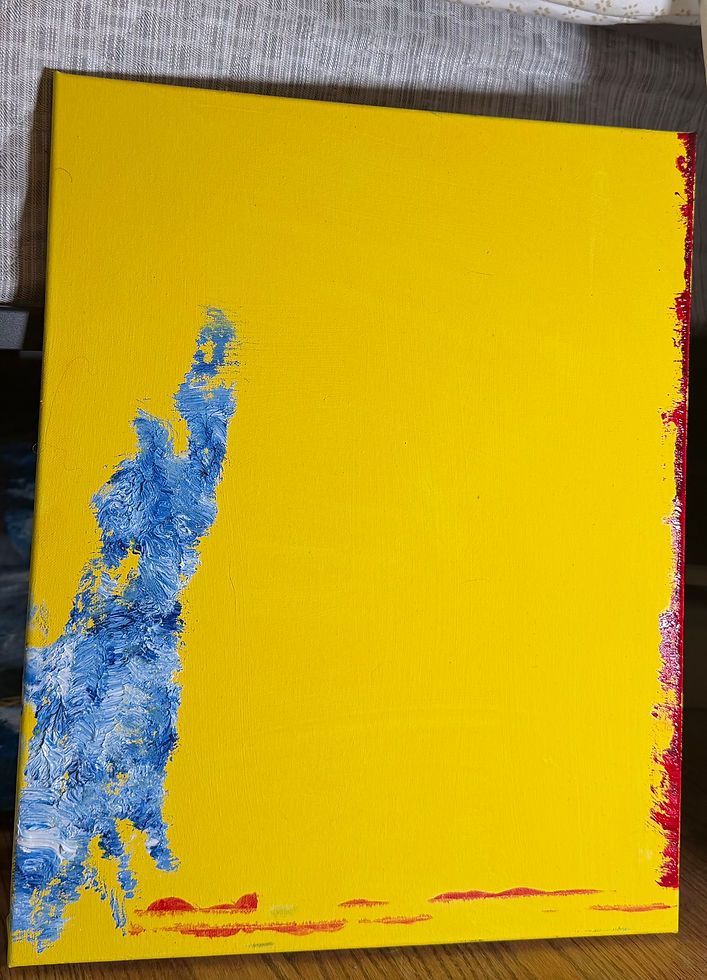
In a former post, I wrote about the shipwreck of my five-canvas plan—and the unexpected salvage that followed. That has now clarified two things: Sanctuary, the golden diptych now live in the gallery under “series,” and Five Wounds, a remaining canvas that is still wrestling its way into existence (now given the original name of the whole series).
It’s clear now that these works are not variations on a single idea. They have mostly decoupled, using the same flat golden ground to perform entirely different kinds of work.
Sanctuary became a threshold—a vestibule before an idea emerges. It is a space of open invitation: a flat color field with just enough friction to give “the viewer’s infinite imagination” a place to catch hold.

The pairing is an expansive space of potential, featuring my poor man’s innovation of a cherished mark. Barnett Newman’s zip appears here as a scarlet suggestion: incomplete right angles, an echo rather than a quotation. It is acting as a distorted catalyst on the gold, inviting you simply to step in, rest, and see what comes.
Five Wounds, on the other hand, is a direct invitation to confrontation: a concentrated form of the original series intention. What was first planned as a sequence of canvases became compressed and distilled into one.

This canvas is a sandbox where I—and anyone—can consider how to process suffering and seek its meaning. It reflects the repeated, paradoxical plea of my own prayer: “Lord, I believe; help my unbelief.”
I know there are immeasurable gifts and meditations to find within the five wounds of Christ; here is a place—perhaps—to contemplate them.
Where Sanctuary invites you to rest your eyes and let peace ignite your mind, Five Wounds asks you to dwell with the mystery of brokenness. Whether one approaches it as a Christian, a monotheist, or a secular viewer, I think both spaces remain necessary: the open room we can step into, and the quiet place where we confront universal truths and search for their meaning.


Comments